
In bilateral interfaces relations with China have also to be given due weight, opines Premvir Das

Mr Rahul Gandhi himself has given seven different prices in different speeches with regard to the Rafale, that is the 2007 offer.
The strategic illiteracy on display in the arguments put forth on the Rafale deal before the Supreme Court is breathtaking, argues Colonel Anil A Athale (retd).

The fiscal deficit of the Centre remains a worry, running at over 6.5 per cent of GDP in April-September 2014, mainly because of revenue shortfalls from exaggerated projections in the government's July Budget and despite the relief on subsidies from lower oil prices.

Defence Secretary R K Mathur should take to Prime Minister Narendra Modi just five simple measures that would create or catalyse dramatic improvements across the wider defence arena, says Ajai Shukla.
The defence ministry needs to focus keenly on "Made in India" projects without being distracted by "Make in India" slogans, says Ajai Shukla

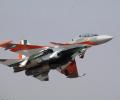
In the light of India's increasingly 'darkening' threat environment and the convergence of strategic interests between China and Pakistan, the IAF's declining combat capabilities are a cause for concern, says Brigadier Gurmeet Kanwal (retd).
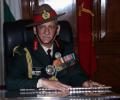
The new army chief's highest priority must be to address the critical hollowness in the Indian Army's operational preparedness, says Brigadier Gurmeet Kanwal (retd).

UK's largest retailer Tesco, Singapore Airlines and Etihad queued up to invest in India as a persistent UPA threw open more sectors to foreign investments with indications of more big ticket deals to be announced in the new year.
Telecom Secretary J S Deepak has resolved the toughest issues facing the sector, but his real test will be in delivering on the govt's Digital India dream
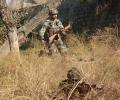
'Jihadi outfits backed by the ISI are now prepared to attack targets not just in J&K, but also in Punjab. This signals an escalation in the range and scope of cross-border terrorism, which cannot be ignored,' says Ambassador G Parthasarthy, former high commissioner to Pakistan.

The Modi government's array of economic policy has been impressive.

A look at the key decisions taken by the Narendra Modi government in its six months.
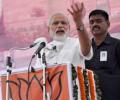
In a first, Prime Minister Narendra Modi on Wednesday met the secretaries of all the government departments collectively and asked them to directly get in touch with him to resolve issues and expedite decision-making.

'Give time to the 2013 Act to work. I not only think that the 2013 law is workable, I believe that the 2013 law is a compromise, a balanced middle path and protects the interests of land owners and livelihood losers.'
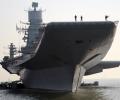
The navy wants to spend Rs 40,000 crore on INS Vishal, a choice the army and air force oppose. This is as much about turf as about funding. explains Ajai Shukla.

Narendra Modi on Monday attacked the Congress-led UPA government over lack of a war memorial as he targeted the massive constituency in the armed forces, minutes after felicitating melody queen Lata Mangeshkar on the 51st anniversary of her memorable song 'Aye Mere Watan Ke Logon'.
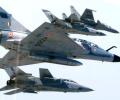
'Though the prime minister has talked somewhat needlessly of pilot projects and the real stuff to come, India cannot be sure of a clean victory in any full-fledged conflict -- even if there is reason to engage in such,' points out T N Ninan.

His view will be shaped by his perception of US world interests and India's economic performance relative to China.

As the Modi government enters the fourth year of its tenure, it is looking more confident, shedding its earlier inhibitions about offering sops or new opportunities to big business, says A K Bhattacharya.

Prime Minister Narendra Modi on Friday told his military commanders that he saw a "rare" possibility of a full scale war but asked them to be ready for "invisible" enemy and challenges which will be "less predictable" in a changing world.

India must present its demands of America confidently, instead of fearing that its pocket will somehow be picked, says Ajai Shukla.
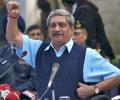
Nitin A Gokhale, Co-founder, BharatShakti.in and long-time Rediff.com contributor, remembers a most unusual politician.

'It appears that Prime Minister Modi has to undo 50 years of State monopoly in the defence sector during which public undertakings like HAL or DRDO monopolised defence production and development with disastrous consequences.'

Defence Minister A K Antony on Sunday said there was no question of any compromise with regard to the case relating to the two Italian marines who had allegedly shot dead two Indian fishermen off Kerala coast in February 2012.

Excerpts from Prime Minister Narendra Modi's speech at the Combined Commanders Conference on board the INS Vikramaditya at sea, off the coast of Kochi.

'There appears to be greater convergence of interests between China and the US in the Afghan-Pakistan theatre than between India and the US. This is hardly a recipe for a super-alliance,' says former foreign secretary Ambassador Shyam Saran.
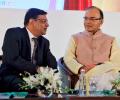
'Who would want to be the man nominally in charge of driving the economy when your boss orders you to swerve it into a ditch of unknown depth?'
'Demonetisation demonstrates that this government is simply too amateurish in terms of economic policy-making to properly address India's deep, deep problems,' argues Mihir S Sharma.
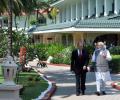
Big ticket defence deals including purchase of missile systems, frigates and joint production of helicopters were sealed on Saturday.
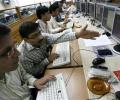
Markets are poised for excellent growth, provided reforms continue to roll

'It is in the interest of both sides that the visit of the US President is seen as being successful. Both sides have invested considerable political capital in it. This rapid exchange of visits and the decisions taken have to be justified, beyond the symbolism, which is no doubt important in itself. This opportunity to impart a fresh momentum to ties should not be missed,' says former foreign secretary Kanwal Sibal.

'With Prime Minister Modi's electoral victory, President Obama very quickly reached out, and we were off to the races.' 'We've seen two highly successful leader-level engagements in the past five months. We've really turned things towards a new beginning -- a new energy, a new momentum...'

Modi's visit to some developed countries such as the US, Japan, China and Australia were sprinkled with humongous investment figures. But do we have the wherewithal to absorb such big investments?

A key government official involved in initiatives to make doing business in the country easier said improving the ranking to 50th in a year was not possible but the country could certainly do that over two years.
.jpg)
The year 2014 was one of the most challenging years for India. For two consecutive years our GDP growth was sub 5 per cent. Employment generation had declined, the revenue buoyancy was low and the country had become investment starved.

He said land is required for rural roads, irrigation, electrification.

China's economy is in transition, with rising wage costs and massive overcapacity.

'I feel more like a chess player, thinking for long hours how to make the next move," Telecom Secretary Aruna Sundararajan tells Surajeet Das Gupta.

The Budget has evoked mixed reactions from Silicon Valley investors.
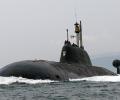
'We have been found seriously wanting in addressing our undersea warfare capability and China's emergence is a cause for concern.'
